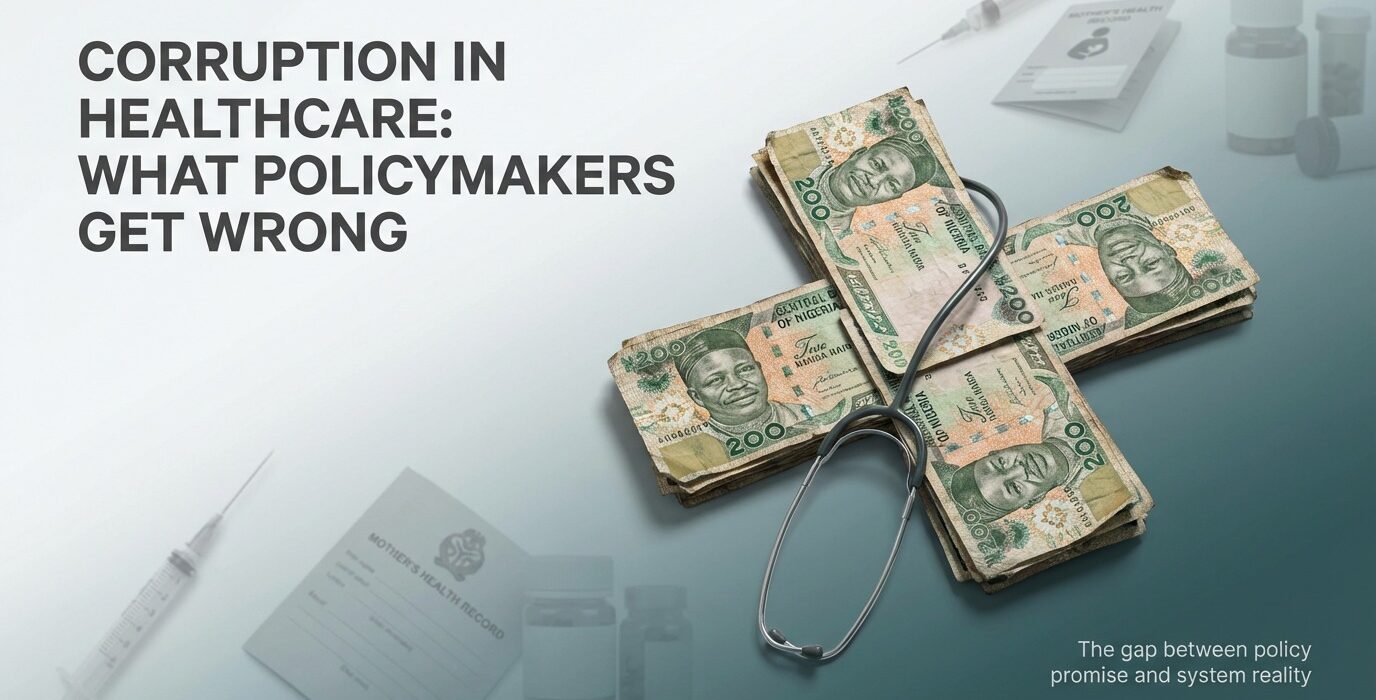
Chika had heard about it all her life: childhood immunisation is free. So, when she delivered her first baby, she did what the system expects of every responsible mother; she went to a public facility for routine vaccination. After hours of waiting, she was finally called in and asked to pay ₦200 for a syringe used in administering the vaccine.
The amount may seem small. But multiply ₦200 by dozens of children, twice a week, across thousands of facilities. What appears trivial at the individual level becomes systemic at scale. More importantly, it violates a simple promise: essential immunisation services are free.
This is not an isolated incident. It is a symptom of something deeper: corruption embedded in everyday health system practices.
Corruption Is Not Just About “Bad People”
In health systems research, corruption is broadly understood as the abuse of entrusted power for private gain. Transparency International and the World Health Organization (WHO) have documented how corruption manifests in health systems globally, particularly in low- and middle-income countries.
Common forms include:
- Informal payments or bribes for “free” services
- Procurement fraud and overpricing of supplies
- Diversion or theft of medicines and vaccines
- Absenteeism and ghost workers
- Nepotism in hiring and promotion
- Manipulation of service data to secure funding
- Facility-level extortion (“pay before your file moves”)
While policymakers often frame corruption as individual moral failure, evidence suggests it is frequently a predictable outcome of weak governance structures, distorted incentives, opaque financial flows, and limited accountability mechanisms.
When reform focuses only on punishment and publicity, corruption adapts. It rarely disappears.
Why Policymakers Get It Wrong
Many anti-corruption initiatives emphasize transparency campaigns, disciplinary measures, and public declarations. These are necessary but insufficient.
Three core misunderstandings often undermine reform:
- Treating Corruption as Exceptional Rather Than Systemic
Corruption in health systems is rarely random. It often thrives where:
- Salaries are delayed or inadequate
- Supervision is weak
- Financial processes are opaque
- Supply chains are unreliable
- Reporting channels are unsafe
In such contexts, informal payments and absenteeism become normalized survival strategies rather than isolated misconduct.
- Ignoring Structural Incentives
Low motivation, poor working conditions, and unclear career pathways create fertile ground for rent-seeking behaviour. When systems reward loyalty over competence or tolerate absenteeism, governance failure, not individual immorality, becomes the core driver.
- Overlooking Procurement and Financing
Procurement is technically complex and politically sensitive. Yet this is where the largest financial leakages occur. Weak contract oversight, lack of price benchmarking, and closed bidding processes allow overpricing and supply diversion. Studies consistently show that opaque procurement is a major corruption risk in health sectors globally.
The Human Cost: Who Pays?
Corruption is not abstract. It reshapes health-seeking behaviour and health outcomes.
Women, children, and rural populations are disproportionately affected. When informal fees are attached to free maternal drugs, some women turn to traditional birth attendants. When staff are absent, patients delay care. When drugs are diverted, stock-outs push families toward expensive private alternatives or untreated illness.
Research across sub-Saharan Africa shows that informal payments reduce service utilization and erode trust in public systems. Over time, corruption weakens both access and quality – the two pillars of universal health coverage.
What Actually Works: Moving Beyond Punishment
Replacing one staff member or issuing public warnings may create short-term compliance. Sustainable reform requires system redesign.
Evidence-informed strategies include:
- Strengthening Financial and Procurement Transparency
- Open contracting and competitive bidding
- Independent price benchmarking
- Digital procurement tracking systems
- Public disclosure of awarded contracts
Digital audit trails reduce discretionary control and create verifiable records of transactions.
- Making Service Rules Visible
- Publicly displayed service charters
- Transparent fee schedules
- Clear referral and admission protocols
- Real-time stock visibility systems
When patients know what is free and what is not, informal charges become harder to justify.
- Embedding Routine Accountability
- Independent facility audits
- Mystery patient surveys
- Spot checks
- Procurement red-flag analytics
These mechanisms detect patterns rather than waiting for whistleblower complaints.
- Protecting Whistleblowers and Complainants
Accountability fails when reporting is unsafe. Confidential grievance systems, fair disciplinary procedures, and visible consequences for misconduct are critical.
- Addressing Incentives and Workforce Conditions
Improved salary reliability, performance-linked incentives, supportive supervision, and clear promotion pathways reduce reliance on informal income streams. Anti-corruption reform is most effective when it aligns incentives, improves oversight, and reduces discretionary power simultaneously.
Conclusion
When governance improves, patients experience tangible change: shorter queues, predictable drug availability, respectful care, and genuine free services where promised. Chika’s ₦200 is not just a small informal fee. It represents the gap between policy promise and system reality. Closing that gap demands more than punishment. It demands redesigning the system so that it works for all.